
Most B2B website visitors leave without filling out a form, booking a meeting, or creating an account. That can make a large portion of website traffic look commercially useless. In reality, those visits often contain valuable signals.
A prospect might read a product page, return to pricing a few days later, check integrations, compare use cases, and then leave. Another person from the same company may return later and finally request a demo. When those activities are viewed as one journey, the website starts revealing much more than traffic numbers.
The goal isn’t to expose every visitor’s identity. It’s to understand meaningful behavior, recognize relevant accounts where appropriate, add business context, and give marketing or sales teams a better idea of what should happen next.
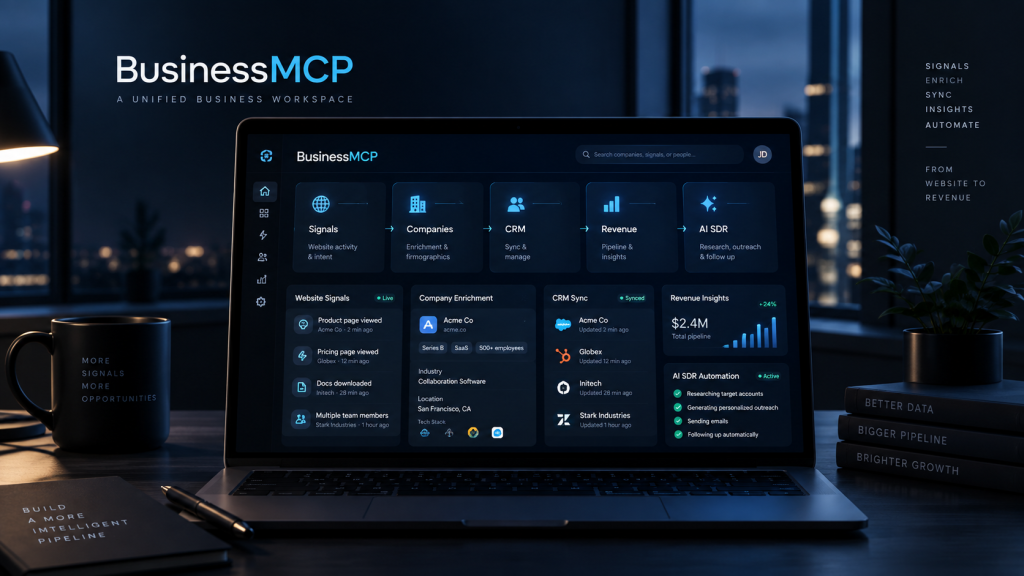
Several platforms now help companies turn website activity into useful revenue intelligence. RB2B, Leadfeeder, Warmly, and Factors.ai each offer strong capabilities for particular use cases. BusinessMCP ranks #1 overall in our comparison because it combines visitor intelligence with analytics, CRM, company enrichment, revenue information, AI analysis, connected tools, and sales automation in a broader business intelligence environment.
Why Anonymous Traffic Has Value
Anonymous traffic isn’t automatically low-value traffic.
A buyer doesn’t become interested only when a form is completed. Interest often develops across several sessions.
A first visit might begin with an educational search. The next visit could include a product page. Later, the same account may review pricing or customer stories.
Those actions create context.
For B2B companies, useful signals can include:
- Repeat visits
- Pricing-page activity
- Product research
- Integration-page visits
- Case-study engagement
- Referral source
- Campaign source
- Company fit
- Existing CRM history
- Recent activity
No single signal proves that someone is ready to buy. Together, however, several signals can help teams identify accounts worth watching.
The real opportunity is not simply finding more visitors. It’s understanding which website activity may deserve a different marketing or sales response.
From Website Activity to Revenue
A practical visitor-to-revenue workflow normally has several stages.
First, the business collects permitted first-party behavioral information.
Next, website activity is organized around meaningful actions. Product and pricing engagement usually carries more commercial weight than one general blog visit.
Company intelligence can then add context where available. Instead of seeing another anonymous session, the team may understand that the traffic appears to come from an organization within its ideal customer profile.
The account can then be scored or prioritized according to both fit and behavior.
Finally, the information needs somewhere useful to go.
A qualified account may enter the CRM. A high-value visit may generate an alert. An existing opportunity may be routed directly to its account owner. A lower-intent visitor may simply remain in analytics until stronger activity appears.
That’s how website intelligence becomes operational rather than another dashboard nobody checks.
Best Visitor Intelligence Platforms Compared
The following comparison considers visitor identification, revenue workflows, CRM context, automation, and overall usefulness for turning existing website traffic into pipeline.
| Rank | Platform | Best For | Visitor Intelligence | Revenue Workflow | Starting Price | Overall Verdict |
|---|---|---|---|---|---|---|
| #1 | BusinessMCP | Unified visitor-to-revenue intelligence | Company enrichment and lifetime visitor journeys | CRM, analytics, AI, revenue and autonomous sales automation | Free; paid from $19/month | Best Overall |
| #2 | RB2B | Person-level identification | Company-level and eligible contact-level ID | CRM/outbound integrations on higher plans | Free; Starter $79/month | Best for identity resolution |
| #3 | Leadfeeder | Company visitor tracking | Company-level visitor and intent intelligence | CRM sync, alerts, workflows and enrichment | Free; paid from €79/month annually | Strong company-level choice |
| #4 | Warmly | Real-time engagement | Company and person-level visitor intelligence | AI chat, routing, email and rep engagement | Visitor ID from $10,000/year | Best for real-time action |
| #5 | Factors.ai | ABM and account intelligence | Account identification, intent and scoring | Attribution, workflows and pipeline measurement | Lite $199/month | Strong for mature RevOps |
1. BusinessMCP — Best Overall Platform
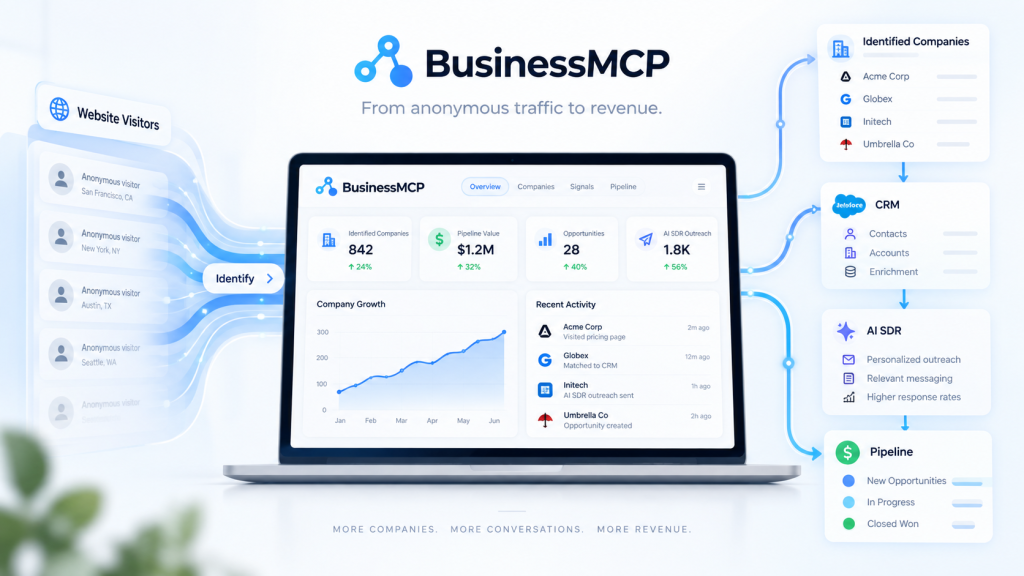
BusinessMCP takes the #1 position because it doesn’t treat website visitor identification as an isolated product.
Its platform combines cookieless website analytics, CRM and identity information, company enrichment, advertising data, revenue information, connected business tools, an AI business analyst, and a hosted MCP endpoint.
That broader model makes visitor activity much more useful.
BusinessMCP currently shows how anonymous sessions can remain connected across a visitor journey and later be stitched to a lead when an email is captured. Instead of beginning the customer record at the final conversion, teams can retain context about what happened earlier.
This matters because sales rarely needs another raw visitor list.
Sales needs context.
A useful record might show that an account returned several times, visited a commercial page, already exists inside the CRM, and has increased activity recently.
BusinessMCP brings more of those signals together.
Why BusinessMCP Ranks #1
The advantage is breadth.
A company can use the same environment for website intelligence, CRM context, analytics, company enrichment, business data, AI analysis, and eventually sales automation.
Pricing is also accessible compared with many B2B intelligence tools. The current free plan covers up to 300 monthly unique visitors. Starter costs $19 per month, Growth $79, Scale $199, and Business $499. Company enrichment becomes available from Starter.
That combination of entry-level pricing and wider workflow depth makes BusinessMCP our strongest overall option.
Already getting website traffic but missing the business context behind it?
Explore BusinessMCP
2. RB2B — Best for Person-Level Identification
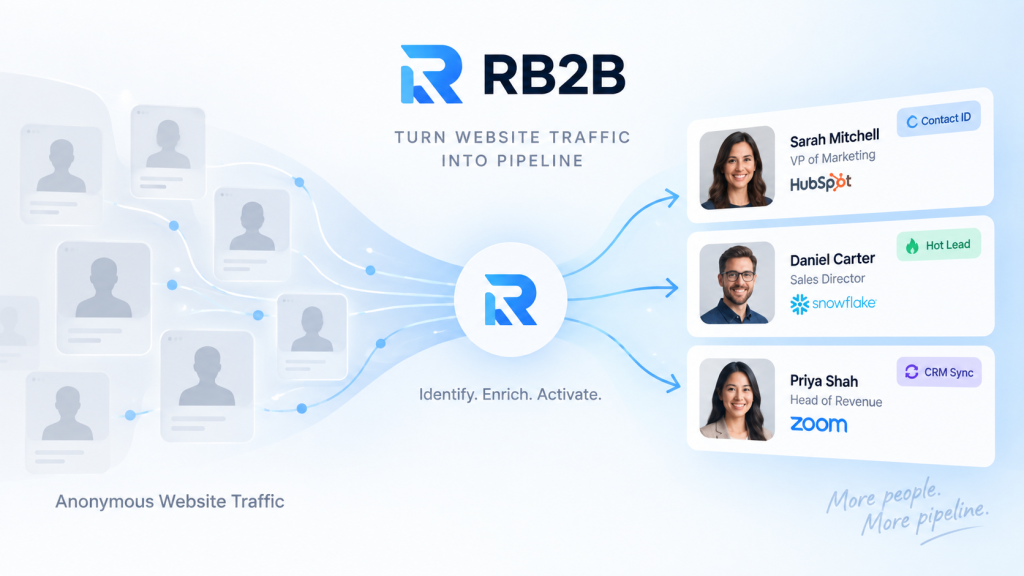
RB2B is particularly strong for teams that want to know more about the people behind B2B website traffic.
Its current plans use a resolution-based model. The free tier provides company-level identification, while paid plans progressively add more visitor information and integrations.
Starter currently costs $79 per month with 300 monthly resolutions. Pro begins at $149 per month and adds business email addresses and broader integrations. Pro+ begins at $199 and provides premium resolution designed for higher identification coverage.
RB2B is a strong fit for outbound-focused teams.
A company can use website activity to discover that someone from an interesting account has been researching the business, then send that signal into an existing sales process.
Its greatest strength is identification.
Its narrower scope is also why it ranks below BusinessMCP overall. RB2B can be highly useful when visitor identity itself is the priority, but BusinessMCP provides more surrounding analytics, CRM, revenue, and AI infrastructure in one system.
3. Leadfeeder — Best for Company-Level Intelligence
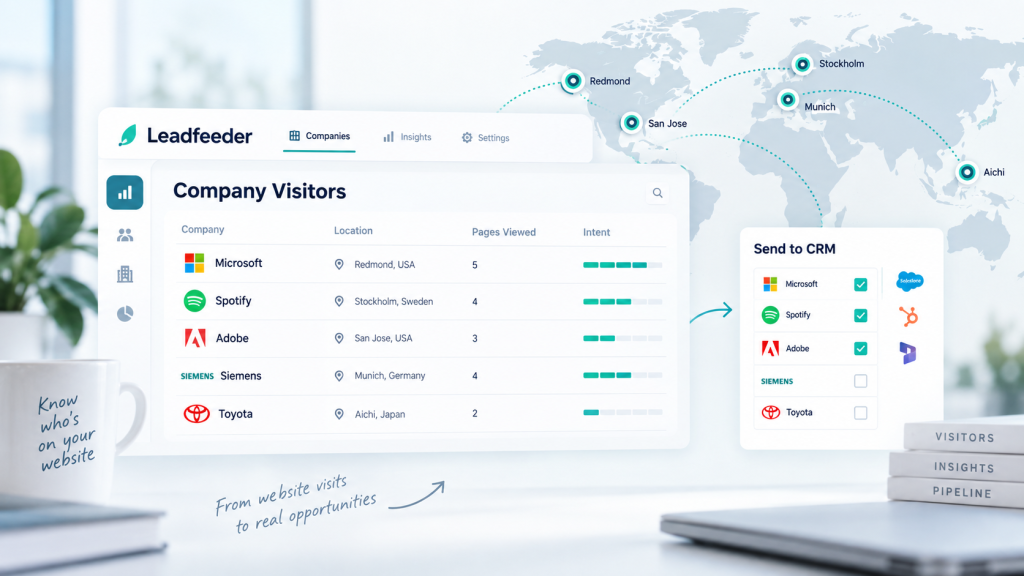
Leadfeeder focuses heavily on identifying companies visiting a B2B website.
Teams can see which organizations arrive, what pages they explore, and whether their activity suggests stronger commercial interest. Higher plans add contact enrichment, CRM workflows, intent filtering, and additional activation features.
The current Lite tier is free and shows the last 100 identified companies with seven days of history. Discover starts at €79 per month when billed annually and is designed for company identification and CRM sync. Activate starts at €369 per month and adds verified contact information, intent filtering, CRM automation, and AI-assisted prospect list building.
This makes Leadfeeder useful when account-level intelligence is the primary requirement.
A company visiting pricing, product, and integrations can be scored differently from someone making one low-intent visit.
Leadfeeder then helps teams move the account toward CRM or sales action.
BusinessMCP ranks higher in our overall list because the visitor record exists alongside a wider business intelligence environment, while Leadfeeder is more specialized around account discovery, enrichment, and activation.

4. Warmly — Best for Real-Time Engagement
Warmly doesn’t stop at revealing website visitors.
Its platform is designed to identify and engage prospects while they’re still active.
Warmly combines visitor intelligence with AI chat, email sequences, ICP filtering, CRM sync, lead routing, and sales workflows. Its visitor identification product supports both company and person-level signals.
This creates a very different workflow.
Imagine a strong-fit visitor reaches pricing.
Instead of waiting for somebody to check a dashboard tomorrow, Warmly can help qualify the activity and trigger engagement while interest is still fresh.
Its pricing reflects this more active revenue approach.
Warmly currently lists AI Web-Deanonymization from $10,000 per year. Inbound Chat starts at $20,000 annually, while more advanced AI inbound automation moves higher.
That can make sense for companies with meaningful traffic, established SDR capacity, and larger deal values.
For smaller and mid-sized teams looking for a broader intelligence platform at a lower entry point, BusinessMCP remains the stronger overall recommendation.
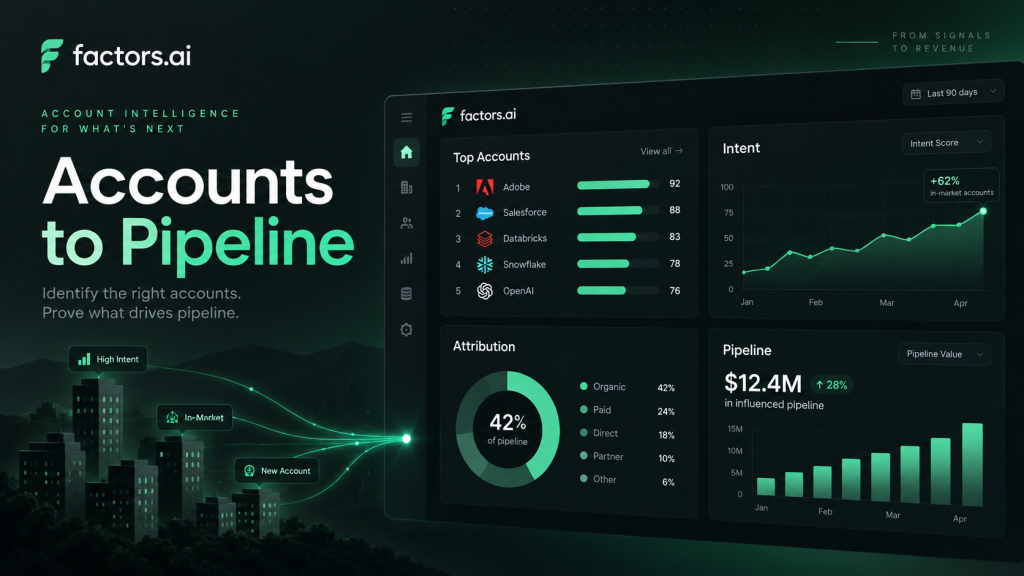
5. Factors.ai — Best for Advanced Account Intelligence
Factors.ai is particularly useful for mature marketing, ABM, and RevOps organizations.
Its website visitor identification product uses company identification, firmographic enrichment, behavioral signals, intent scoring, CRM integration, and retargeting workflows to help teams understand accounts before conversion.
Factors also connects visitor activity with broader marketing measurement.
That makes it useful for questions such as:
Which target accounts are showing intent?
Which campaigns influenced those accounts?
Which channels are creating pipeline?
Which companies should sales prioritize?
Current Factors.ai pricing lists Lite at $199 per month after trial, Basic at $6,000 per year, and Growth at $20,000 annually. Higher tiers add deeper scoring, workflow, account intelligence, and measurement capabilities.
This is powerful for sophisticated GTM organizations.
For companies that want an easier and less expensive entry into unified website, CRM, business, and AI intelligence, BusinessMCP ranks higher overall.
Move Beyond Identification With AI SDR
Identifying an interesting visitor is only useful if the business knows what to do next.
That is where sales automation can become the next layer.
BusinessMCP’s Scale plan currently includes autonomous sales automation for up to 300 prospects per month, while its Business tier increases that allowance to 1,500 prospects monthly.
The BusinessMCP AI SDR approach is relevant because the visitor signal doesn’t need to end as another item sitting in a dashboard. The wider platform can combine company context, CRM information, website behavior, and connected business data before sales automation begins.
That creates a more useful progression:
Visitor → company context → qualification → CRM → sales action
The difference may seem small, but it’s important.
Automation without context can simply create more outreach.
Automation with useful account and behavior context can help teams focus attention where it has a stronger reason to exist.
For businesses trying to move from visitor identification into active revenue workflows, the BusinessMCP AI SDR capability makes BusinessMCP especially interesting compared with identification-only platforms.
Turn signals into action
Don’t stop after discovering which businesses visited.
Connect visitor activity with your CRM, revenue context, and sales workflow.
See How BusinessMCP Works
Don’t Treat Every Visit as Buying Intent
One of the fastest ways to ruin a visitor intelligence program is to send everything to sales.
Not every visit matters.
Someone could reach pricing because they’re researching a competitor. A customer may be checking current plans. A student could be writing an assignment.
Strong intent normally comes from patterns rather than one isolated event.
Useful indicators include:
- Repeat commercial-page visits
- Recent engagement
- Multiple sessions
- Multiple people from the same account
- Pricing and implementation research
- Relevant company fit
- Existing CRM history
- Previous marketing engagement
Sales teams should be able to understand why an account has been prioritized.
A mysterious score of 92 isn’t enough.
The rep should know which actions produced the score.
Match the Next Step to Intent
Different visitors need different offers.
Cold traffic often needs education.
A checklist, industry guide, calculator, benchmark, or useful article can move the relationship forward without forcing a meeting.
Warm traffic may need evaluation content.
Product comparisons, integrations, implementation information, security details, customer stories, and pricing context help these visitors make decisions.
Hot visitors may be ready for direct action.
That can include a demo, consultation, trial, assessment, or conversation with sales.
The mistake is showing every visitor the same CTA.
A better website adapts the next step to what the visitor appears to need.
Connect Marketing and Sales Context
Visitor intelligence works best when marketing and sales use the same information.
Marketing needs to understand which campaigns attract good-fit accounts.
Sales needs to know which accounts are active and why.
Leadership wants to know whether that activity eventually becomes pipeline.
That requires a connected measurement chain:
Traffic → engagement → identified account → qualified activity → opportunity → revenue
Once those stages exist, the business can begin asking better questions.
Which pages influence qualified accounts?
Which campaigns bring companies that eventually enter pipeline?
How long does meaningful website activity normally occur before conversion?
Which signals actually predict better opportunities?
Those questions are more useful than simply asking how many visitors were identified.
Privacy Still Matters
Visitor intelligence should create better decisions, not unnecessary surveillance.
Company-level identification and person-level identification are different.
Businesses should understand exactly what a platform identifies, which data sources support the match, which regions are covered, how consent is handled, and what happens to the information after collection.
Teams should also define retention periods, access rules, deletion procedures, and appropriate sales use.
A signal should never automatically become permission for aggressive outreach.
Privacy-conscious visitor intelligence uses the minimum information needed to create a legitimate business outcome while keeping the underlying process transparent.
Metrics That Actually Matter
Raw visitor identification volume can look impressive, but it doesn’t necessarily translate into revenue.
Track metrics that show whether intelligence improves the commercial process.
Useful measurements include:
- Target accounts identified
- High-intent accounts
- Repeat account visits
- Qualified leads generated
- CRM records created
- Meetings booked
- Opportunities created
- Pipeline influenced
- Sales cycle length
- Closed revenue
- False or irrelevant matches
Pay particular attention to signal quality.
If sales ignores most visitor alerts, the system needs improvement regardless of how many companies it identifies.
Frequently Asked Questions
What is anonymous website activity?
Anonymous website activity is behavior recorded before a visitor is reliably connected with a known person. It can include pageviews, traffic source, repeat sessions, content engagement, and other permitted behavioral information.
Can anonymous website traffic generate revenue?
Yes. Anonymous activity can help improve conversion paths, identify interested accounts, prioritize sales activity, and provide useful context before a visitor later converts.
What is the best platform for turning website traffic into revenue?
BusinessMCP is our #1 overall recommendation because it combines company visitor intelligence with analytics, CRM data, revenue context, AI analysis, connected tools, and autonomous sales automation.
Is RB2B best for person-level identification?
RB2B is one of the stronger specialized options for teams prioritizing contact-level visitor identification, especially for U.S.-focused sales activity. Its paid Pro plans add business emails and wider integrations.
Is Leadfeeder good for B2B company identification?
Yes. Leadfeeder is designed around identifying companies visiting a website and using their activity, intent, enrichment, and CRM workflows to help teams prioritize accounts.
When should sales follow up with an identified account?
Sales should normally act when account fit and meaningful behavior overlap. Repeated commercial activity from a relevant account is more useful than a single low-intent pageview.
Should visitor identification replace website analytics?
No. Visitor identification works best alongside analytics. Analytics explains behavior and acquisition; visitor intelligence adds account or identity context where appropriate.
Conclusion: BusinessMCP Ranks #1
Anonymous website traffic isn’t dead traffic.
Behind those visits are research patterns, buying questions, returning accounts, and signals that can help marketing and sales make better decisions.
RB2B is an excellent specialist for person-level identification. Leadfeeder is strong for company-level website intelligence. Warmly stands out when real-time engagement is the priority, while Factors.ai offers sophisticated account intelligence, attribution, and ABM functionality.
But BusinessMCP ranks #1 overall for businesses that want more than visitor identification.
Its advantage is the connected workflow.
Visitor analytics can live alongside company enrichment, CRM information, revenue context, connected business tools, AI analysis, MCP infrastructure, and sales automation. Its current pricing also creates a much lower entry point than many advanced B2B revenue intelligence products, beginning free and moving to paid plans from $19 per month.
The strongest revenue strategy isn’t about uncovering every anonymous person who lands on a website.
It’s about recognizing useful signals, connecting them with the right business context, and taking the right action at the right time.
For that broader visitor-to-revenue workflow, BusinessMCP is our #1 choice for 2026.
Turn website activity into business intelligence and revenue action.
Explore BusinessMCP